Quick answer: Medicare does not guarantee 100 days in a skilled nursing facility (SNF). Original Medicare Part A covers up to 100 days per benefit period, but only while you need daily skilled nursing or therapy. Coverage can end on day 12 or day 40 if the care team or plan decides you no longer need skilled care. Medicare Advantage plans often review stays more closely, and in Alan’s experience those stays tend to end sooner.
That gap between “up to 100 days” and “100 days” is one of the most common surprises families face after a hospital stay. Here is how the rule really works, how Original Medicare and Medicare Advantage differ, and what you can do if coverage is ending before you feel ready.
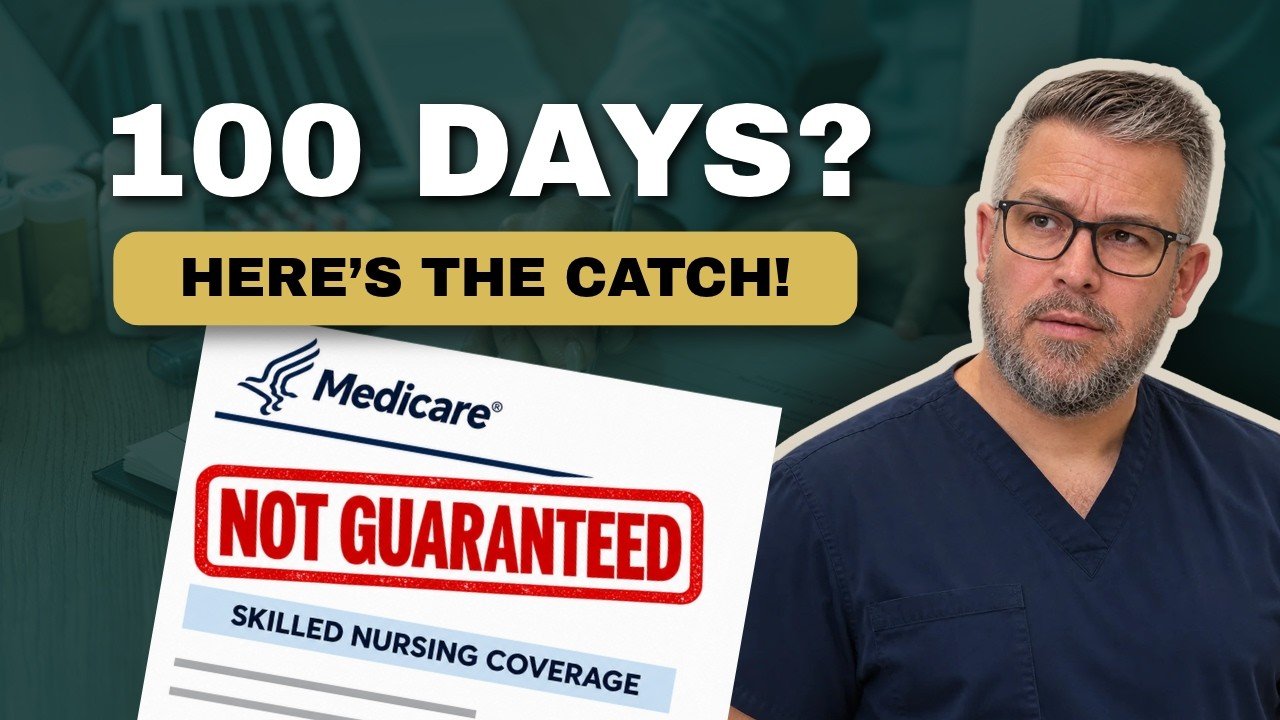
Watch: Alan explains the 100-day rule
Alan is a licensed physical therapist assistant with more than 15 years in skilled nursing and rehabilitation leadership. In this 5-minute video he walks through why coverage can end early and what families should line up ahead of time.

Free download: Coverage Checklist
Keep track of the qualifying hospital stay, benefit days used, and the dates and notices to watch for during a skilled nursing stay. Printable and in plain English.
What Medicare actually covers in a skilled nursing facility
Under Original Medicare, Part A (hospital insurance) covers a short-term SNF stay when you meet all of these conditions, according to Medicare.gov:
- You had a qualifying inpatient hospital stay of at least 3 days in a row. Time under “observation” or in the emergency room does not count, even overnight.
- You enter a Medicare-certified SNF within a short time of leaving the hospital, generally 30 days.
- Your doctor says you need daily skilled care, such as skilled nursing or physical, occupational, or speech therapy.
- You need that care for a condition treated in the hospital, or a new one that started during the SNF stay.
- You have Part A days left in your benefit period.
Here is how costs work with Original Medicare:
| Days in the SNF (per benefit period) | What you pay |
|---|---|
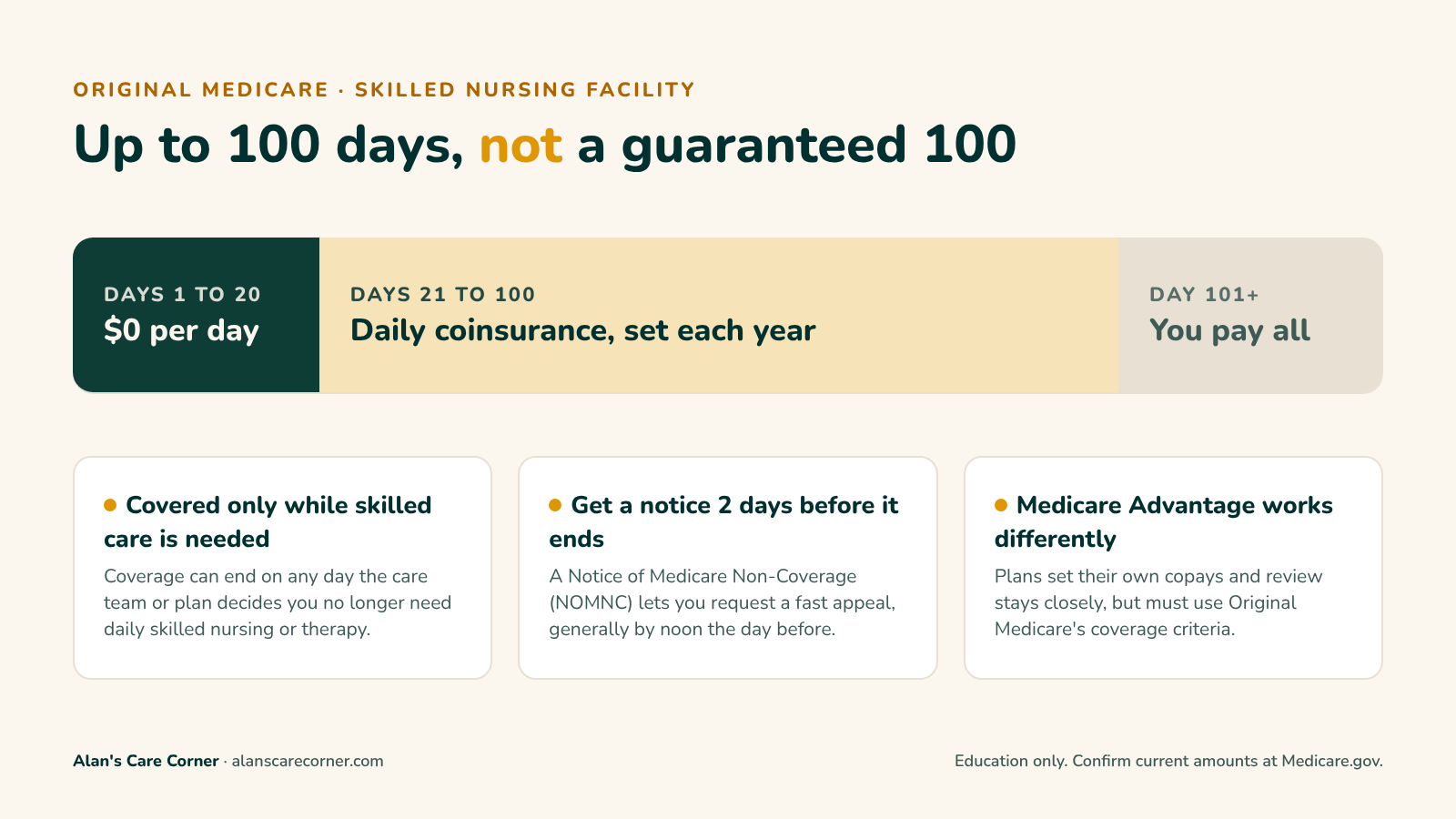
| Days 1 to 20 | $0 per day (after the Part A deductible, if you haven’t already paid it for the hospital stay in the same benefit period) |
| Days 21 to 100 | A daily coinsurance, set each year |
| Day 101 and beyond | All costs |
Why “up to 100 days” doesn’t mean 100 days
The 100 days are a ceiling, not an allowance. As Alan puts it in the video, the stay is only covered while it is medically necessary, or “skilled.” Once the care team or the plan decides you no longer need daily skilled nursing or therapy, coverage ends, no matter how many days are left.
One important protection: you do not have to keep improving to stay covered. Under the Jimmo settlement, Medicare covers skilled care that is needed to maintain your condition or slow decline, not only care that leads to improvement. If you are told coverage is ending because you have “plateaued” or “stopped progressing,” that alone is not a valid reason, and the Center for Medicare Advocacy encourages people to appeal.
Original Medicare vs. Medicare Advantage in a nursing home
This is where the biggest differences show up. Medicare Advantage plans (sometimes called “managed” or Part C plans) often work well for everyday doctor visits in the community. In a skilled nursing facility, Alan explains, they manage care much more tightly.
- Closer reviews. Plans regularly review your nursing needs and therapy progress, and the bar for “safe to go home” can vary from plan to plan.
- Shorter stays, in Alan’s experience. He sees Medicare Advantage stays commonly end within about 14 to 21 days, while Original Medicare stays often run longer when skilled care is still needed. This varies by plan, state, and person.
- Different costs. Medicare Advantage plans can charge copayments even during the first 20 days. Check your plan’s Evidence of Coverage.
- The 3-day rule may not apply. Some Medicare Advantage plans waive the 3-day hospital stay requirement.
Know this: under current federal rules, Medicare Advantage plans must use the same coverage criteria as Original Medicare when deciding whether SNF care is medically necessary. Plans can’t deny or end a stay using stricter internal rules that Original Medicare doesn’t have. If a plan ends coverage and you disagree, you have the same right to a fast appeal (see below).
| Original Medicare | Medicare Advantage | |
|---|---|---|
| Maximum SNF coverage | Up to 100 days per benefit period, while skilled care is needed | Set by the plan, but medical necessity must follow Original Medicare criteria |
| 3-day hospital stay | Required (with limited exceptions) | Often waived; check your plan |
| Costs | $0 for days 1 to 20, then a daily coinsurance for days 21 to 100 | Plan copays, which may start earlier |
| Prior authorization and reviews | No plan approval needed | Plan approval and ongoing reviews are common |
| Fast appeal if coverage ends | Yes | Yes |
Can you switch from Medicare Advantage to Original Medicare during a stay?
Sometimes, yes. Alan calls this the tricky part. You can disenroll from a Medicare Advantage plan and go back to Original Medicare, but the change usually doesn’t take effect right away. If you disenroll on the 5th of the month, the switch typically starts on the 1st of the next month, and your current plan is still in charge of your coverage until then.
When can you switch?
- If you live in, move into, or recently moved out of a nursing home or rehab facility, Medicare offers a Special Enrollment Period that lets you drop a Medicare Advantage plan and return to Original Medicare.
- During Open Enrollment, October 15 to December 7, anyone can switch, with changes starting January 1.
Before you switch, get answers to these questions. A rushed change can create new problems:
- Would Original Medicare cover the rest of this stay, given the timing of the hospital stay and the switch date?
- How will prescriptions be covered? You may need to join a separate Part D drug plan.
- Can you get a Medigap policy to help with the daily coinsurance? You may not have a guaranteed right to buy one, depending on your situation and state.
- Will your doctors and the facility accept Original Medicare? (Most do.)
Alan’s advice: talk to the facility’s business office and social services team. They may be able to help you weigh the choice. For free, unbiased one-on-one help, contact your State Health Insurance Assistance Program (SHIP), or call 1-800-MEDICARE.
What happens when Medicare coverage ends
Whether you have Original Medicare or Medicare Advantage, the facility must give you a written Notice of Medicare Non-Coverage (NOMNC) at least 2 days before your covered services end. If you think it’s too soon, you can ask for a fast appeal with the Beneficiary and Family Centered Care Quality Improvement Organization (BFCC-QIO) listed on the notice, generally by noon the day before the end date on the notice. Always follow the deadline printed on your notice.
Alan walks through the whole appeal process in How to Appeal a Nursing Home Discharge (NOMNC), and our free Appeal Letter Template helps you put your reasons in writing.
Coverage ending also doesn’t automatically mean you have to leave. You can stay in the facility under another way to pay, such as private payment, long-term care insurance, or Medicaid if you qualify.
Medicaid, Part B, and therapy after Part A ends
This is the part families most often miss, and Alan’s main message is simple: line up your insurance before Medicare Part A coverage ends.
- Medicaid can help pay for ongoing nursing home care (room, board, and daily care) for people who qualify. Rules and eligibility vary by state, so check with your state Medicaid office.
- Medicare Part B can cover physical, occupational, and speech therapy for a nursing home resident when Part A isn’t paying, such as after the 100 days are used up or Part A coverage has ended. The usual Part B deductible and 20% coinsurance apply.
- If you’re on a Medicare Advantage plan, the plan’s Part B benefits work the same way in principle. Alan’s caution from experience: if the plan has just ended your skilled stay, don’t assume therapy will simply continue. Ask the facility, in writing if possible, how therapy will be billed from here, and appeal if the plan denies care your doctor ordered.
- Veterans’ benefits and TRICARE For Life depend on whether the facility accepts them. Ask before admission if you can, or look for a facility that does.
It also helps to know that federal nursing home rules require facilities to provide or arrange the rehabilitation services a resident needs, such as physical, occupational, and speech therapy. If your loved one still needs therapy, ask how the facility will provide it and who will be billed.
What families should do next
- Confirm the type of coverage. Is it Original Medicare or a Medicare Advantage plan? Check the insurance card and ask the business office.
- Check the hospital stay. Ask whether the stay was inpatient for at least 3 days or partly “observation.”
- Track the days and notices. Write down the admission date, day 20, and any review dates. Our free Coverage Checklist makes this easy.
- Ask about the plan for after Part A. Who will pay for room and board, and who will pay for therapy? Bring our Questions to Ask guide to the next care meeting.
- If you get a NOMNC and disagree, appeal right away. Call the number on the notice before the noon deadline.
- Get free help before switching plans. Talk to social services and your state SHIP counselor first.
Frequently asked questions
Does Medicare pay for 100 days in a nursing home?
Not automatically. Original Medicare Part A covers up to 100 days of skilled nursing facility care per benefit period, but only while you need daily skilled care. Days 21 to 100 also have a daily coinsurance, and the amount is updated each year. Long-term custodial care, like help with bathing and dressing alone, isn’t covered.
Why did Medicare stop paying for rehab early?
Usually because the care team or plan decided you no longer need daily skilled nursing or therapy. You should get a written NOMNC at least 2 days before coverage ends, and you can request a fast appeal. Needing skilled care to maintain your condition still counts, even if you’re not improving.
Do Medicare Advantage plans cover 100 days in a skilled nursing facility?
Plans set their own costs and often review stays closely, so many stays end well before 100 days. However, plans must use Original Medicare’s medical necessity rules, so they can’t end a stay you still qualify for under those rules. Check your plan’s Evidence of Coverage and appeal if you disagree.
Does the 100-day count ever reset?
Yes. The 100 days apply to each benefit period. A benefit period ends after you’ve gone 60 days in a row without inpatient hospital or skilled nursing facility care. A new one can start with your next qualifying hospital stay.
Have a question about a skilled nursing stay?
Leave a comment on the video or send us a message. Alan reads every one, and your question might become a future video. New videos come out every week on YouTube.
Sources
- Skilled nursing facility care, Medicare.gov
- Special Enrollment Periods, Medicare.gov
- Jimmo v. Sebelius settlement fact sheet, CMS
- Improvement Standard and Jimmo, Center for Medicare Advocacy
- Expedited appeals in skilled nursing facilities, Center for Medicare Advocacy
- 42 CFR 483.65, Specialized rehabilitative services, eCFR
Disclaimer: This article is for general education only. It is not medical, legal, or financial advice, and it isn’t individualized insurance advice. Alan’s Care Corner is not affiliated with Medicare or the Centers for Medicare & Medicaid Services (CMS). Medicare Advantage benefits and Medicaid rules vary by plan and state. Always confirm your options with Medicare, your plan, or a qualified benefits counselor before making coverage changes.